
Is your story similar to mine? I had been working on client projects most of the day, with some interruptions to generate proposals, look into billing, liaise with colleagues, and schedule calls. It was late in the afternoon, and I had to get home to take a child to a sports activity. Do I fill out my timesheet, or just go and fill it out tomorrow? Like many, I went home, and said I’d fill it out tomorrow. Did I? Well, when I got into the office the next day, there were 10 urgent emails that needed addressing, so I did that. Back to the evening, and it’s the same story. Friday hits, and now I have to enter my time, but I have no idea what I did on Monday. So I comb through my emails, look at my notes, and reconstruct my time. Feasible, but annoying, time-consuming, and definitely not best practice.
In this blog, we will discuss
- Cost of time tracking
- Why the free method you are using is very expensive
- Results of our time tracking study of more than 200 people
- Downstream problems with your current methods
- A free solution that also actually saves you time and energy
Two of the cofounders of TimeCatchApp were technical consultants, producing solutions for customers. One was in the software development industry, while another ran a consulting organization with revenue > $160M annually, as part of an S&P 500 company in the life sciences sector.
Using Excel?
If you have to spend even a single hour in a week tracking your time and entering the results into a timesheet, even if that timesheet is an Excel spreadsheet, then that time will cost you a significant amount of money. Let’s assume you charge your customers $150/hr. Under this very conservative assumption, your time tracking is costing you
50 hr * $150 / hr = $7,500
allowing for 2 weeks of vacation, or roughly $8,000.
The problem with this calculation is that the assumptions are incorrect. When we started, we studied one of our companies and found that consultants were spending around 30 minutes per day. That works out to 100 hours per year, or a cost of $15,000!
Actual Time Spent: Study
Hard data on how much time consultants, independent contractors, and freelancers actually spend on time tracking is challenging to get. Google’s Gemini doesn’t know either, but it does have some “thoughts” on how much time is spent on administrative tasks.

So we did a time tracking study involving more than 200 individuals who provide contracting services working in the life sciences industry.
On average each member was spending approximately 3 hours per month just entering data into the timesheets. That is a cost of $5,400 per employee. But there is more bad news. Where do they get the data from? Writing the time in notebooks, or putting it in Excel spreadsheets (or Google Sheets, or …), where you have to track your project codes manually.

Study: Each member was spending … 3 hours per month
Private study of more than 200 individuals
Tracking the time in personal logs consumes at least twice the time of data entry, or 6 hours per month. That is a total of $16,200 per employee! This is between 2% to 6% of the time spent just tracking time.
| Activity | Hours / month | Annual cost |
| Enter time | 3 | $5,400 |
| Tracking time | 6 | $10,800 |
| Total | 9 | $16,200 |
Time Spent, Not Recorded
But there is even more bad news. What about the time you forgot to put into the personal log? That is just gone. If you have more than 3 active projects at any given time, there is a high probability you are losing some time on those projects with this approach. For T&M work you are giving income away, and for fixed work you are not getting good data on how much time it actually takes to complete a project.
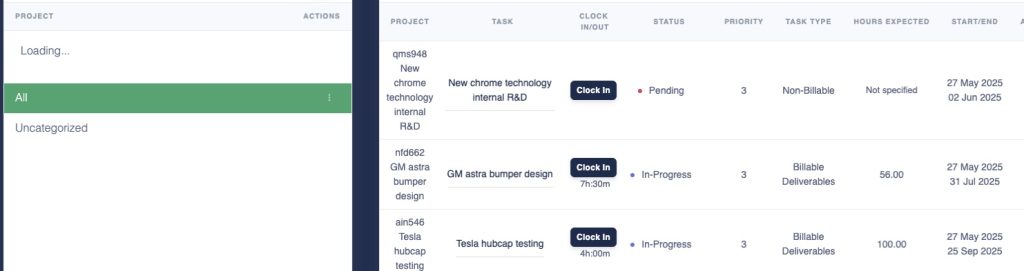
That’s where a one-touch time tracking approach like TimeCatchApp is useful. It takes very little effort to click on a button: You do not need to think about what you are doing, it takes just a second for each task switch, it provides information on how you are doing versus your budget in real-time, and there is no time sheet entry at the end.
Below is a screen shot of the same set of work, but notice how much more information is available. No computing, no need to stop what you are doing and enter “=sum(G1:G7)” in a spreadsheet, no timesheet entry, and no retyping the information into an invoice document.
In Excel, this information sits in a silo, not useful for invoicing or analyzing your time. Let’s now look at that cost.
Gotta Get Paid, But At What Cost?
And this takes us to the next place we lose time and money: Invoicing. In our experience from running a large consulting organization, the process of generating an invoice can take someone several hours every month. Why? You have to collect which deliverables you can invoice for (monthly status meeting = 1 hour), what times you can invoice (many emails back and forth for several hours each month for both invoice and consultant), entry of information into the invoice document, plus checking (1 – 3 hours per month), checking to make sure that any thing on this months invoice was not on last month’s invoice (30 minutes) and sending the document (5 minutes). You are now up to 3.6 hours per month, or 43 hours per year. That is a cost of $6,450. This process is starting to add up.
But wait, there is more! Do you, or someone you know, forget to enter their data into the timesheet? You might have a timesheet application or just a spreadsheet that is shared, but it is essentially the same, tedious process that no one likes and is a waste of everyone’s time. It was the best we had 20 years ago, but is ancient method today. Hence the emails when timesheets are due, and the reminding of the delinquents. In my last organization, the managers spent at least 5 hours per month, while the consultants spent an additional hour reading and deleting the emails and replying that they were complete. We are now an additional $1,800.
So our costs for this ad hoc tech stack is now starting to add up. It is running you around $24,540 per year. That could pay for a pretty nice car in a few short years.
| Activity | Hours per year | Annual cost |
| Time tracking | 108 | $16,200 |
| Invoicing | 43 | $6,540 |
| Organizing data entry | 12 | $1,800 |
| Total | 163 | $24,540 |
Easy Solution
With an integrated tech stack like TimeCatchApp, you save all of that time and cost, risk of duplicate billing, eliminate the need to hold status meetings since the app knows the status of every task and every project, and you can keep track of the payments and know exactly what the financial status is. And everyone sees the same information, which is current in real-time.
Conclusion
Your process is costing somewhere between $8,000 and $24,000 per year, based on our most recent time tracking study, and the manual process annoys everyone as a necessary evil, and furthermore is prone to errors that can cause mistrust with your customer. TimeCatchApp addresses each of these problems:
- Almost no time spend tracking your time as only a button is clicked to start and stop timing
- No need to enter time into timesheets because all time is tracked continuous
- Status is known to all in real time
- Invoices automatically use only the newest data and never any old data, no need to double check, and no need to risk your customer relationship by entering data into your invoice manually
👏Bonus benefit: Use the automatic invoicing feature so that you don’t even need to remember to do that! The system will generate the invoice all by itself so you can take your kids to the ball game. True, you will still need to review and send to your client (click one button to send!), but you will get the reminder that the invoice is ready to go.
And be sure to check out the document storage solution. It does more than Box: It organizes your files the way your projects are, so you never lose track of an important document again!