
By Vanita Reeve
On this page
Quick AnswerBackgroundPersonasA Small Image ExperimentOutputs From the PromptsDirect ComparisonConclusionFinal ThoughtsFAQReduce context-switching costQuick Answer
If you’re looking for the best AI image generator, there isn’t a single winner.
- ChatGPT excels at structured, literal interpretation.
- Gemini excels at creative atmosphere and visual storytelling.
- Claude excels at research and image discovery rather than native image generation.
The better question is not “Which AI is best?” but “Which AI is best for this task?”
As consultants, we constantly evaluate tools that help us work faster and deliver better results. AI systems have become part of our daily workflow, from research and writing to business analysis and image creation.
I initially approached image generation with a simple question: Which AI creates the best images?
After testing ChatGPT, Gemini, and Claude using the same prompt, I realized that was the wrong question.
Just as these systems exhibit different personalities in conversation and writing, they also approach image-related tasks differently. Rather than searching for a single winner, I found myself treating them as different creative specialists—each bringing distinct strengths to the team.
To explore this idea, I ran a simple experiment using the same personality-based prompt across all three platforms.
We use AI systems in our consulting work, in our business processes, and even for our personal activities. As a consultant or freelancer, you surely use these systems as well. Since our time is money, we need to allocate it on the tools that leverage our expertise the best. And hence this investigation.
I wanted to know which team member had the best image generation. That was the wrong question. The image generation capabilities have very similar personas to the text generation. It’s not who is the best, but how to use the team members best to solve a problem.
To look at the image generation personas, I did a little experiment, and this is what I found.
This is my experience. This is how I think of these AI artists. This is not a scientific experiment. Treat this as what I learned as a user of these systems, using them to solve real business problems.
Background
In a LinkedIn post,, I discussed the personas of ChatGPT, Gemini, and Claude. Based on my experience working with each, I thought of these systems as if they had personalities, as their personas. Because they had distinct personas, the conclusion was that we should treat these not as competitors, but as members of a team, each with their own strengths and weaknesses. And we can use this diversity of personas to create a better team.
But what about image generation? Do these personas carry over to that as well? Let’s find out. The 3 image generation models that I am looking at are:
- OpenAI added image generate through the DALL-E 3 model
- Gemini uses the Nano Banana model.
- Claude does not have an integrated image generator, but sources data from other locations, and provides the citations.
Personas
The conclusion from the last article was that each AI had distinct personas, described as:
- Chatgpt: Bookish, analytical, puts information into boxes, likes ratings and logical thinking, very smart, good writer, balanced
- Gemini: Very knowledegable, optimistic, creative, empathetic, quick, very smart, extrovert
- Claude: Tech-savvy, slower and detail-oriented, very smart, introvert, thinker
From our experience, we can break down the comparisons in a summary table.
| Feature | ChatGPT | Gemini | Claude |
|---|---|---|---|
| Native Image Generation | Yes | Yes | No |
| Best Strength | Literal interpretation | Creative atmosphere | Research & sourcing |
| Image Style | Structured | Expressive | Reference-based |
| Text Integration | Excellent | Moderate | N/A |
| Ideal Use Case | Marketing graphics, presentation graphics | Concept exploration, headline graphics, example graphics | Finding references of non-AI images with appropriate semantic meaning |
| Challenges we have experienced | When prompts were more limited, the structure was not adequate. Required better prompting | Words misspelled and could not be corrected. Requires back and forth to get right image. Gemini watermark. | Limited to what it can find on the web. |
A Small Image Experiment
To test the inherent behavioral differences of each model, I ran an experiment: I fed the exact descriptions of my three “AI Personas” back into all three platforms as an image-generation prompt.
Testing was conducted in May 2026 using the free versions of ChatGPT, Gemini, and Claude. Each platform received the prompt below without modification.
The Prompt: “Please produce images for each of these personalities: 1. Bookish, analytical, puts information into boxes, likes ratings and logical thinking, very smart, good writer, balanced. 2. Very knowledgeable, optimistic, creative, empathetic, quick, very smart, extrovert. 3. Tech-savvy, slower and detail-oriented, very smart, introvert, thinker.”
So, what happened? What were the results?
Outputs From the Prompts
ChatGPT
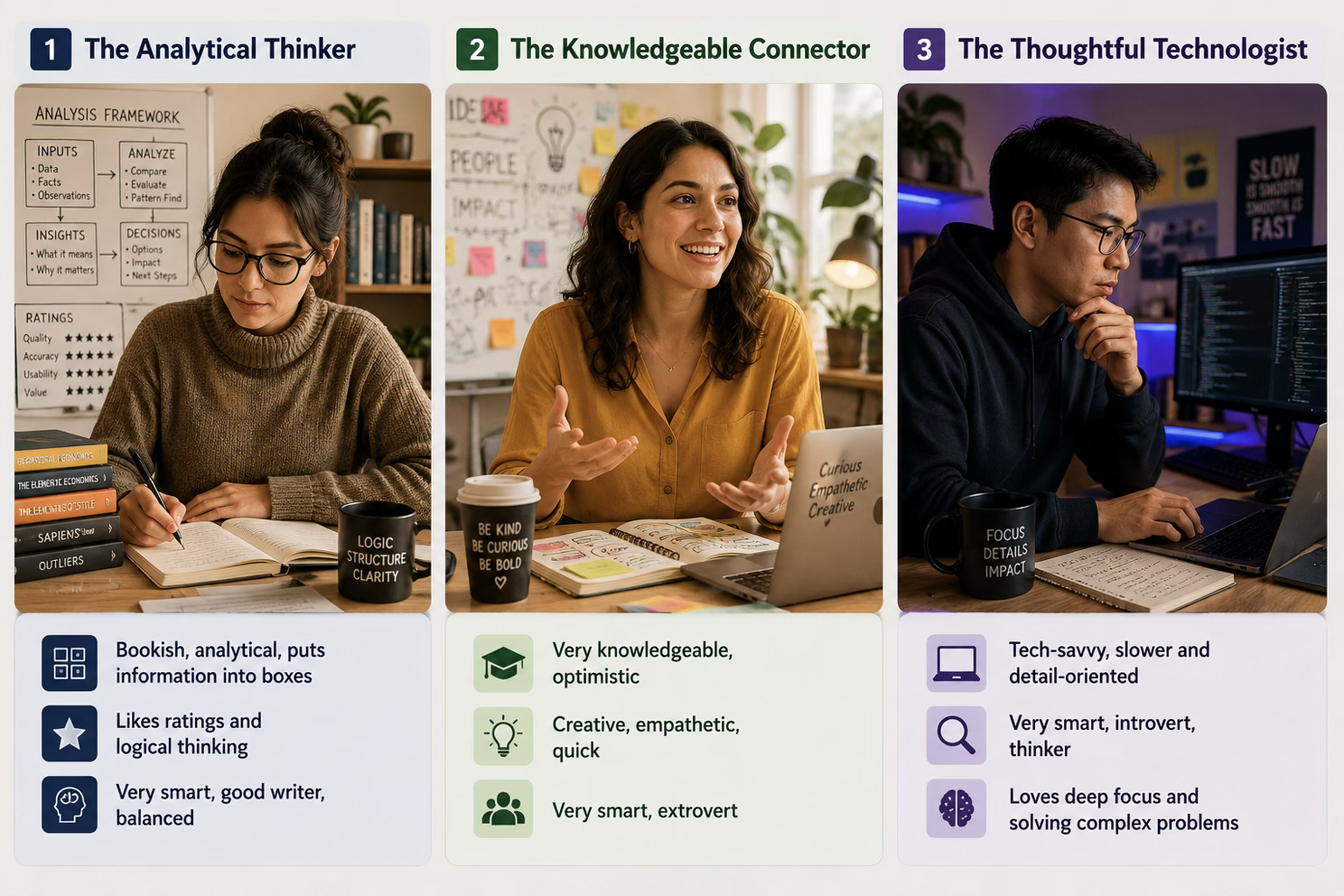
Below is the ChatGPT rendering of the 3 personas. Note inclusion of title and descriptive text along with images. Nicely organized, using text as reinforcement for the images.
Gemini
Below is the Gemini rendering of the 3 personas. The images are combined into one, and are free standing. Also note the strong watermark on the image.

Claude
Below is the Claude rendering of the 3 personas, or rather 3 renderings of the personas. Behaving true to form, Claude takes the prompt and returns images in the most straightforward manner. Anyone with experience with computer scientists will recognize this trait immediately. We got 3 images for each persona.
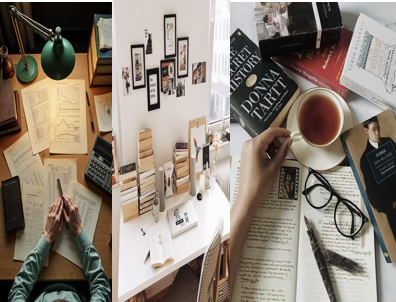
Image sources
Personality 1 — The Analytical Bookworm: organized desk, surrounded by books and notes, everything neatly categorized.
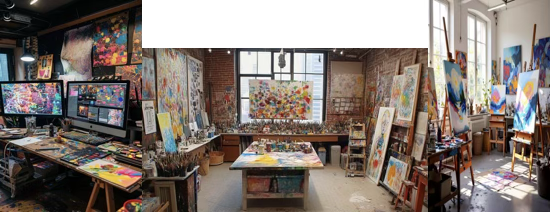
Image sources
Personality 2 — The Energetic Creative: vibrant, colorful, bursting with ideas and inspiration — an extrovert’s natural habitat.

Image sources
Personality 3 — The Deep-Thinking Tech Introvert: a quiet, focused, multi-monitor setup — minimal distractions, maximum depth of thought.
Direct Comparison
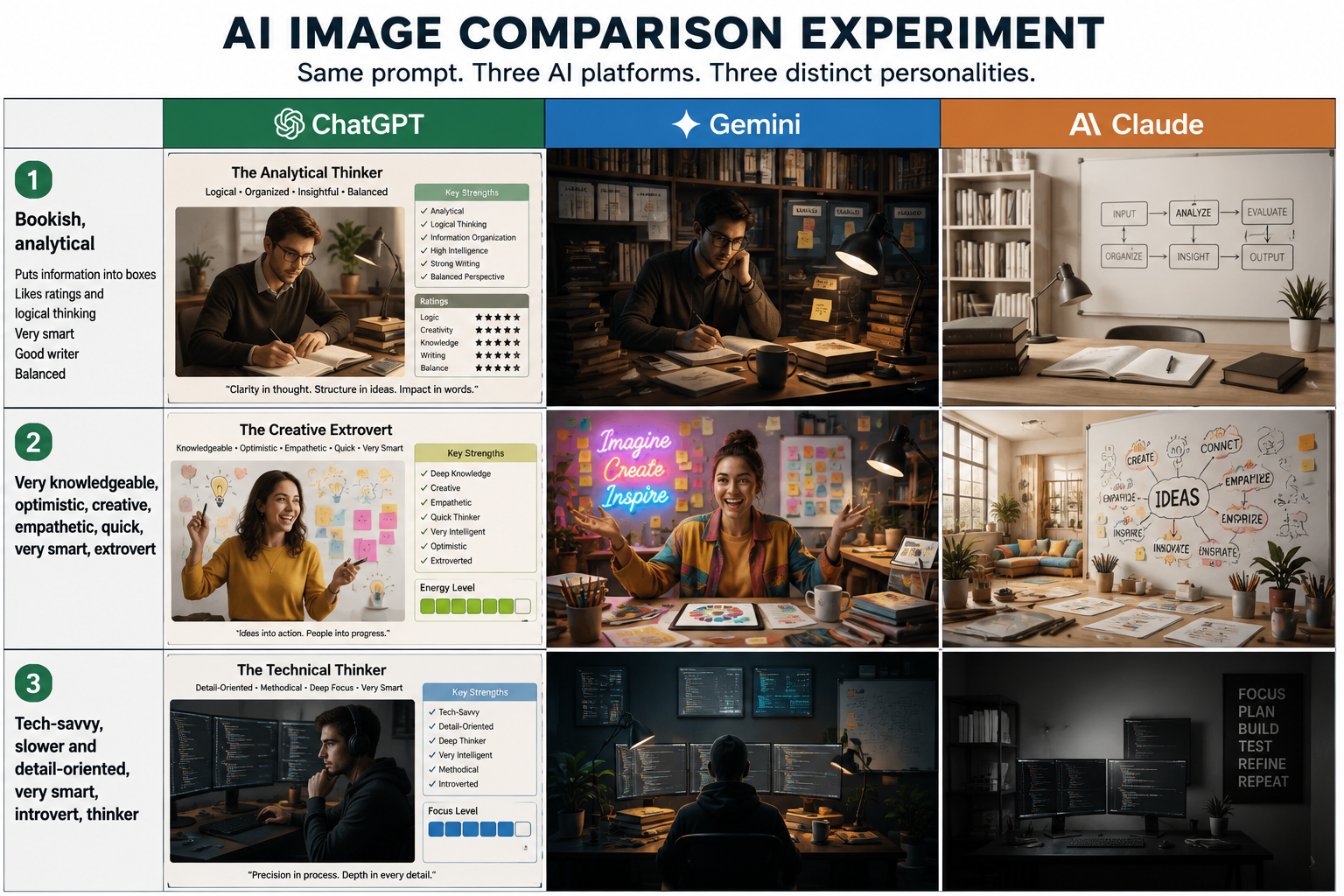
We asked Gemini to combine the images into one so that we could see the differences side by side. Here is what you get. This starkly contrasts the styles you get out of each. Note that the Claude images are from stock photos as Claude itself does not have a built-in image generator. However, if you wish to work with Claude there are a number of alternative image generators available, some for free and others with a subscription fee. This in itself should not be considered to be a reason to eschew Claude.
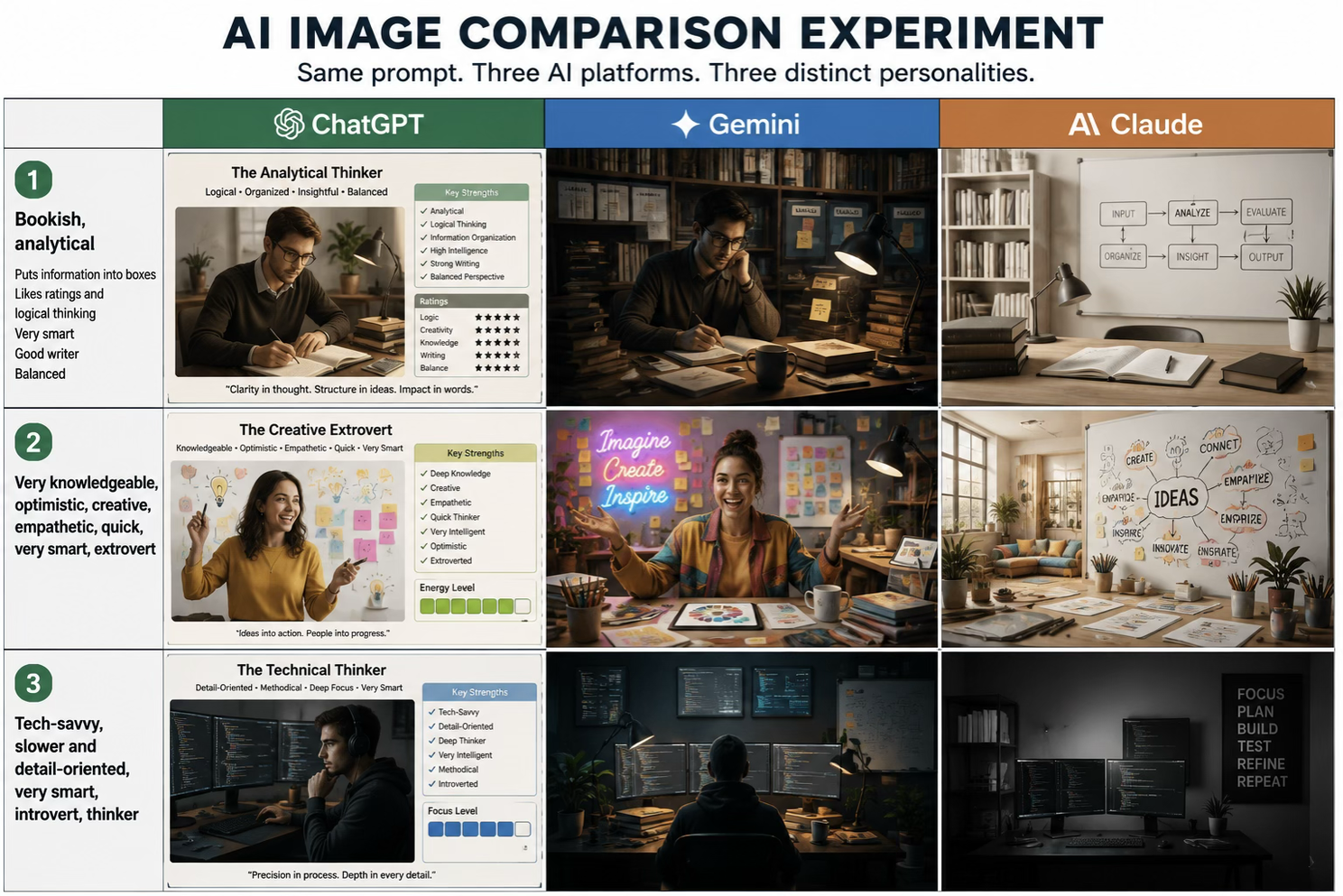
The visual results were surprisingly consistent with my earlier observations, but they also revealed how each platform’s underlying architecture approaches the same creative task differently.
ChatGPT: meticulously labeled and itemized all the descriptive qualities, utilizing its standard, native generation to output solid, highly literal character images. ChatGPT free users do face daily image-generation limits, which encouraged a more selective approach to experimentation than Gemini’s higher free-tier image-generation allowance.
Gemini: took the creative interpretation a step further, blending vibrant character designs with rich environmental backgrounds that effectively captured the atmospheric “vibe” of each personality.
Claude: took a character-free, database-driven approach—delivering clean, unpopulated stock images of the physical environments (like a multi-monitor tech desk) where those tech personas would live. Since Claude’s free tier does not currently include native image generation, it responded by locating and organizing publicly available images through web search.
Conclusion
The most interesting result wasn’t that one platform produced better images than the others. It was that each platform interpreted the same prompt through its own lens.
ChatGPT approached the task like an organized analyst, Gemini behaved like a visual storyteller, and Claude acted like a researcher assembling reference materials.
That mirrors the personalities I observed in their text-based interactions.
For consultants, freelancers, and business owners, this suggests a useful shift in thinking. Instead of asking which AI is best, ask which AI is best suited for the specific problem you’re trying to solve.
The future may belong less to a single AI assistant and more to teams of specialized AI collaborators working together.
Final Thoughts
Using these tools, we found that we can generate very good images very quickly. But if you are generating an image from scratch, you need to be very specific. Often times it will take several iterations to get the image to be what you want. Even then, we have spelling mistakes that are incredibly sticky, even when the AI admits that it made a spelling error.
Images that need specific text or logos will often need some touch ups using a non-AI systems. In this case, we will take an image, download it, and edit it using Gimp or similar image editing software. On the Mac, the Preview function is surprisingly agile for these minor touch ups, and it is easy to learn. So you may need to treat the image generated by these AI systems as a very good first step, but not as the final version. The human touch and judgment is still needed. The image generation capabilities have very similar personas to the text generation. We learned that the question to ask is not which is the best, but which team members to solves the problem best.
FAQ
Is ChatGPT or Gemini better for image generation?
ChatGPT tends to produce more structured and literal interpretations of prompts, while Gemini often creates more atmospheric and visually expressive scenes.
Does Claude generate images?
Currently Claude does not include a native image generator. Instead, it can locate and organize relevant images from external sources.
Which AI image generator is best for business use?
The answer depends on the task. ChatGPT is strong for graphics that require structure and text, Gemini is strong for creative concept development, and Claude can help locate visual references and supporting materials. You can use these as a team, utilizing the strengths of each system.
Can AI-generated images replace human designers?
AI dramatically speeds up image creation, but human review and editing remain important, especially when accuracy, branding, text, or logos are involved. We have used traditional image editing tools to “clean up” the final image.
Reduce context-switching cost
Context switching is costing you hours. Regain your time with TimeCatchApp, your consulting practice operating system. Try it today for free at TimeCatchApp.com/register. No credit card needed.