
Written by Russell Reeve, PhD. LinkedIn profile: linkedin.com/in/russell-reeve
On this page
Project Management Software Built for Consulting WorkKeep Work OrganizedWhy Consulting Projects Lose VisibilityWhat Makes Project Management Software Different for Consultants?Connect Projects To Business OperationsReduce Administrative OverheadFrequently Asked QuestionsDeliver Better OutcomesRelated PagesProject Management Software Built for Consulting Work
Project management software for consultants should do more than track tasks.
Consulting firms need visibility into deliverables, deadlines, budgets, resources, documents, client communications, time tracking, invoicing, and project profitability.
Unfortunately, many consulting firms still manage these activities across multiple disconnected systems, creating unnecessary administrative work and reducing project visibility.
TimeCatchApp provides project management software for consultants that connects project execution, time tracking, documentation, client management, and invoicing within a single workflow.
The result is greater project visibility, fewer status meetings, and more time spent delivering value to clients.
Keep Work Organized
Projects contain many moving parts:
- Tasks
- Deliverables
- Deadlines
- Documents
- Budgets
- Team responsibilities
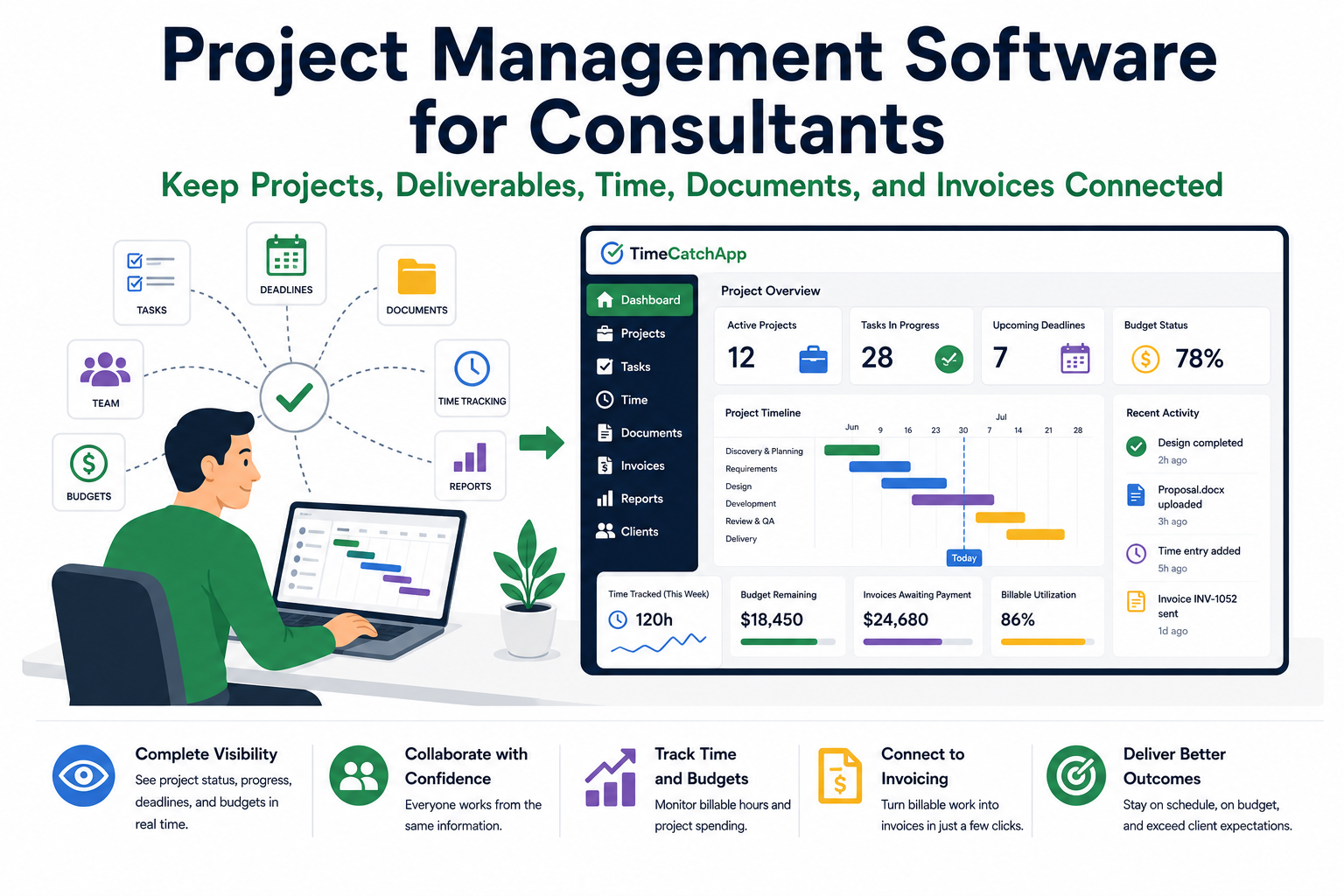
TimeCatchApp brings these elements together in one environment so everyone understands the current state of the project.
Projects are organized as a series of tasks. These tasks can be fine grained or rather coarse, depending on the needs of the project.
Tasks can be broken down into successor tasks for those that depend on a sequence. For example, a document can be produced in task A, and QC of the document can be assigned to task B, which triggers only once A is completed. Each task can be assigned to different individuals, but they share the context to make communication free flowing.
All task information is stored and presented to all who are working on the task, including deadlines, budgets, documents, and more.
With this sharing of the context, the project manager can spend more time orchestrating the project and less dealing with administrative functions, reducing communication friction for all involved in the project.
Why Consulting Projects Lose Visibility
In many consulting organizations, project managers spend a substantial portion of their day communicating project status, gathering updates, coordinating resources, and maintaining project records.
The more disconnected the systems become, the more time is spent collecting information rather than managing outcomes.
To reduce this time spend and allow project managers to better manage the projects, TimeCatchApp provides visibility into:
- Task progress
- Upcoming deadlines
- Resource allocation
- Budget consumption
- Billable activity
TimeCatchApp provides this visibility down to the individual contributors, with the data updated in real-time. A contributor to a task knows in real-time what the hourly budget is for the task and how much is left. This allows teams to identify issues early and take corrective action, without the need for costly status update meetings where obsolete data are reviewed.
The goal of project management is not to collect status updates. The goal is to solve client problems.
Russell Reeve, PhD
TimeCatchApp automates project visibility so consultants can spend less time reporting and more time delivering.
What Makes Project Management Software Different for Consultants?
Consulting projects differ from many internal business projects.
Consultants must manage:
- Client expectations
- Billable hours
- Deliverables
- Resource allocation
- Contracts
- Invoices
- Project profitability
As a result, consulting firms often require more than traditional task management software.
Project management software for consultants should connect project execution directly to time tracking, financial reporting, invoicing, and client communications.
This visibility helps consulting firms improve utilization, profitability, and client satisfaction.
Connect Projects To Business Operations
Most project management tools stop at task tracking. Traditional project management systems such as Microsoft Project excel at scheduling and dependency planning.
However, consulting firms often require additional capabilities, including time tracking, invoicing, document management, client management, and financial visibility.
As a result, many consulting organizations end up maintaining multiple systems to support a single client engagement.
Consulting firms need better, more efficient, more autonomous solutions.
TimeCatchApp connects project execution with:
- Timeline automatic updates
- Time tracking
- Task completion status
- Documentation
- Financial reporting
- Invoicing
- Client management
The result is a complete operating system for consulting work, where 80% of the communication work is done by the system, leaving the project manager to solve problems for the clients and coordinate between the client and internal teams.
Reduce Administrative Overhead
Every disconnected process creates additional work.
By bringing project execution, documentation, time tracking, and billing together, TimeCatchApp reduces the administrative burden placed on consultants and project managers.
If 80% of the time is spent on communication and this is reduced by 80%, then only 16% will be spent on these activities. At $200/hr that is a savings of $5,504 per month, or $66,048 per year. The major driver of the cost of Microsoft Project is the $1129.99 licensing fee (price from Microsoft website on 16 July 2026), but the cost of the project manager time.
Frequently Asked Questions
What is project management software for consultants?
Project management software for consultants helps consulting firms plan, organize, execute, and monitor client engagements.
Unlike generic task management applications, project management software for consultants typically includes capabilities such as:
- Task management
- Deliverable tracking
- Resource allocation
- Time tracking
- Budget monitoring
- Document management
- Client collaboration
- Project profitability reporting
The goal is to provide visibility into the entire consulting engagement so that projects are delivered on time, within budget, and to client expectations.
What is the difference between project management software and consulting practice management software?
Project management software focuses primarily on planning and executing work.
Typical features include:
- Task management
- Scheduling
- Dependencies
- Milestones
- Resource planning
- Progress reporting
Consulting practice management software extends beyond project execution and includes operational functions such as:
- Client management
- Time tracking
- Invoicing
- Financial reporting
- Payment tracking
- Document management
- Team utilization reporting
Many consulting firms start with project management software and later discover they need additional systems to support the business side of consulting.
Practice management software brings these activities together into a single environment.
Why do consulting firms need project management software?
Consulting projects often involve multiple deliverables, deadlines, team members, stakeholders, and client expectations.
Without a structured system, project information can become fragmented across email, spreadsheets, documents, and meetings.
Project management software helps consulting firms:
- Improve project visibility
- Clarify responsibilities
- Monitor deadlines
- Track budgets
- Reduce communication overhead
- Identify risks earlier
- Improve client delivery
The result is better project execution and more predictable outcomes.
How does project management software improve project visibility?
Project visibility comes from having accurate information available when it is needed.
When project tasks, budgets, deliverables, documents, deadlines, and time records are stored in separate systems, project managers often spend significant time collecting information before they can make decisions.
Project management software improves visibility by providing a centralized view of:
- Project progress
- Task status
- Resource assignments
- Budget consumption
- Deliverables
- Upcoming deadlines
This allows managers and team members to identify issues sooner and make informed decisions based on current information.
Can project management software track billable hours?
Some project management platforms include integrated time tracking, while others require a separate time tracking system.
For consulting firms, connecting project management and time tracking is especially important because project profitability often depends on billable utilization.
When billable hours are connected directly to project tasks and deliverables, firms gain better visibility into:
- Project costs
- Resource utilization
- Budget performance
- Invoice preparation
- Project profitability
Integrated systems reduce duplicate data entry and improve reporting accuracy.
How does TimeCatchApp connect project management and invoicing?
TimeCatchApp connects project activities directly to financial operations.
As consultants complete tasks and record time, billable activities remain associated with the project where the work occurs.
This allows consulting firms to:
- Track billable work in real time
- Monitor project budgets
- Generate invoices automatically
- Track payments
- Measure project profitability
Instead of manually transferring information between project management tools, time tracking systems, and invoicing software, information remains connected throughout the engagement lifecycle.
What is professional services project management software?
Professional services project management software is designed specifically for organizations that sell expertise rather than products.
Examples include:
- Consulting firms
- Engineering firms
- Accounting firms
- Legal practices
- Marketing agencies
- Technology service providers
These organizations must manage client relationships, deliverables, billable time, project budgets, and profitability.
As a result, professional services project management software often includes features that are not found in traditional project management systems, such as time tracking, invoicing, resource utilization reporting, and client management.
Is Microsoft Project suitable for consulting firms?
Microsoft Project is a powerful project scheduling and planning tool that has been widely used for decades.
It excels at:
- Timeline planning
- Dependency management
- Resource scheduling
- Critical path analysis
However, many consulting firms require additional capabilities beyond project scheduling.
Consultants often need to manage:
- Client relationships
- Time tracking
- Deliverables
- Documents
- Invoicing
- Payments
- Project profitability
As a result, consulting firms frequently combine Microsoft Project with other systems to support their operational workflows.
Organizations seeking a more integrated approach may prefer platforms that connect project execution with time tracking, financial management, documentation, and client management.
Why do consulting firms spend so much time in status meetings?
Status meetings often become necessary when project information is not easily accessible.
If team members must manually report progress, update spreadsheets, search for documents, or communicate task completion through email, managers spend significant time gathering information before they can make decisions.
Modern project management systems reduce the need for status meetings by providing real-time visibility into project activity.
When task status, deadlines, budgets, and deliverables are visible to everyone involved, project teams can spend less time reporting progress and more time making progress.
What causes consulting projects to lose visibility?
Most consulting projects do not lose visibility because of a lack of expertise.
Visibility is often lost when information becomes fragmented across multiple systems.
Common causes include:
- Disconnected project tools
- Email-based communication
- Scattered document repositories
- Manual status reporting
- Separate time tracking systems
- Independent invoicing processes
When project information is spread across multiple locations, it becomes difficult to understand the true state of the engagement.
Keeping project information connected helps firms identify issues earlier, improve collaboration, and reduce administrative effort.
How does TimeCatchApp reduce project management overhead?
TimeCatchApp reduces project management overhead by keeping project information connected.
Tasks, deliverables, documents, budgets, time records, invoices, payments, and client information remain associated with the same project context.
This reduces the need to:
- Search for information
- Update multiple systems
- Recreate project history
- Conduct unnecessary status meetings
- Transfer data between applications
By reducing administrative work and improving visibility, project managers can spend more time solving client problems and less time managing project records.
What should I look for when choosing project management software for consultants?
When evaluating project management software for consultants, consider whether the platform supports the entire consulting workflow.
Look for capabilities such as:
- Task and deliverable management
- Time tracking
- Budget monitoring
- Resource allocation
- Document management
- Client management
- Automated invoicing
- Financial reporting
- Project profitability tracking
The most effective systems connect project execution to business operations, reducing administrative effort while improving visibility and control.
For consulting firms, project management is not simply about tracking tasks. It is about delivering projects profitably while maintaining complete visibility throughout the engagement lifecycle.
What is the difference between Asana, Microsoft Project, and project management software for consultants?
Asana and Microsoft Project are both well-known project management platforms, but they were designed to solve different problems than those faced by many consulting firms.
Asana is primarily focused on task management, collaboration, and workflow coordination. It helps teams organize work, assign responsibilities, track deadlines, and monitor progress across projects.
Microsoft Project is focused on project planning and scheduling. It excels at creating project timelines, managing dependencies, allocating resources, and analyzing project schedules. It is especially popular for large projects that require detailed planning and critical path analysis.
Both tools can be highly effective within their intended use cases.
However, consulting firms often need more than task management or scheduling.
Consultants typically need visibility into:
- Client relationships
- Project deliverables
- Billable hours
- Resource utilization
- Project budgets
- Documents
- Invoices
- Payments
- Project profitability
As a result, many consulting firms find themselves using multiple systems simultaneously.
For example, a consulting firm might use:
- Asana for project management
- A separate time tracking application
- A document repository such as Box or SharePoint
- Accounting software for invoicing
- A CRM platform for client management
Each tool may perform its individual function well, but consultants often spend considerable time moving information between systems, updating records, searching for documents, and preparing reports.
This creates administrative overhead and increases the risk of missing information.
Project management software designed specifically for consultants takes a broader approach.
Rather than focusing solely on tasks or schedules, it connects the entire consulting workflow.
This often includes:
- Project management
- Time tracking
- Deliverable management
- Client management
- Document management
- Financial reporting
- Invoice generation
- Payment tracking
The goal is to maintain visibility throughout the entire client engagement, from proposal and project kickoff through final invoice and payment.
For consulting firms, the question is not whether Asana or Microsoft Project are good tools. Both are proven platforms with large user communities.
The more important question is whether your firm benefits from managing project information across multiple systems or from keeping project execution, client information, financial activity, and documentation connected within a single environment.
As consulting organizations grow, many discover that project visibility depends less on creating better schedules and more on maintaining complete project context.
When tasks, documents, time records, deliverables, invoices, and client communications remain connected, project managers spend less time collecting information and more time helping their teams deliver successful outcomes.
Deliver Better Outcomes
Successful consulting firms create value through execution.
TimeCatchApp helps teams stay organized, maintain accountability, and keep projects moving forward.
Start your free trial and discover consulting project management software designed for modern consulting practices.
Related Pages
Consultant Time Tracking Software